No babysitting anymore: open models on a small full-stack feature with the Claude Code harness
Quick read
The test
The same feature, built four times from the same spec with my staged workflow and Claude Code as the harness: Opus with Sonnet, GLM-5.3 with DeepSeek-v4.1-flash, Sonnet with Haiku, DeepSeek-v4.1-flash with GLM-5.3-flash.
The result
The four builds delivered the same game, green on the repository's full quality gate. I played each one on the tablet, three of them as a blind test, and saw no difference in the result. This was a small feature though.
The cost
$21.03 for GLM and DeepSeek versus $16.50 for Opus and Sonnet; $2.72 for DeepSeek and GLM-flash versus $2.77 for Sonnet and Haiku. The open models used six to nine times more tokens.
My take
Open models can do the job in my orchestrator, without babysitting. For now, a frontier model subscription is still the better deal from a pricing perspective, for my usage.
Introduction
When I started exploring and testing open-source models in May 2026, I found myself babysitting my agents a lot. I had an OpenClaw setup with multiple agent personas, each with its own role, and getting from an issue to a PR was not straightforward. I had a clear process for development, but the agents needed guidance and a clearer orchestration. So I started building my own orchestrator.
In the previous post, Comparing agentic orchestration with the Claude Code harness, I compared workflows on Claude models: my staged workflow, Claude Code orchestrating its own subagents, and a plain Claude Code session. This post keeps one workflow, the staged one, which is my custom workflow, and changes the models: the feature, the spec and the harness (Claude Code) stay the same, and the models are Claude models or open models.
I chose GLM-5.3 and DeepSeek-v4.1-flash because I read on OpenRouter that GLM was equivalent to Opus and DeepSeek to Sonnet, so I expected them to perform as well as Opus and Sonnet. Here I got it wrong: OpenRouter ranks models by usage, not by quality, and independent benchmarks put both lower. On the Artificial Analysis Intelligence Index of October 2026, at their maximum reasoning setting, both score 32, compared with 58 for Opus 5.5 and 36 for Haiku 5.5.
The questions I wanted answered: how do open models perform against Claude models in the same harness? What differs in the unit tests, the coverage and the end-to-end (e2e) tests? Did the open models need more senior validation, or were they autonomous, and were they retried more than the Claude models? How much did they cost compared with Claude models of the same tier? And which open model is a good compromise between quality and price?
1. The setup and workflow
The detailed specs, the intent and the architecture are produced by a previous step, done with a human in the loop and validated by a human before the actual implementation starts. The specs were produced with the BMAD method for product specifications, and every run started from the same code baseline and the same specs.
The feature
The feature is a Snake game for Familio, a personal app I’m building with my children to track chores with rewards, with a game space. The stack is a full-stack Node.js application in TypeScript, with Astro, React, Vitest and Playwright. In the game, the player’s snake hunts computer-driven bad snakes, grows as it eats them and speeds up as it goes. The specification resulted in one epic with three stories:
- the hunt engine;
- the hunt in the record and on the parent’s card;
- the hunt’s tile, grid and screens.
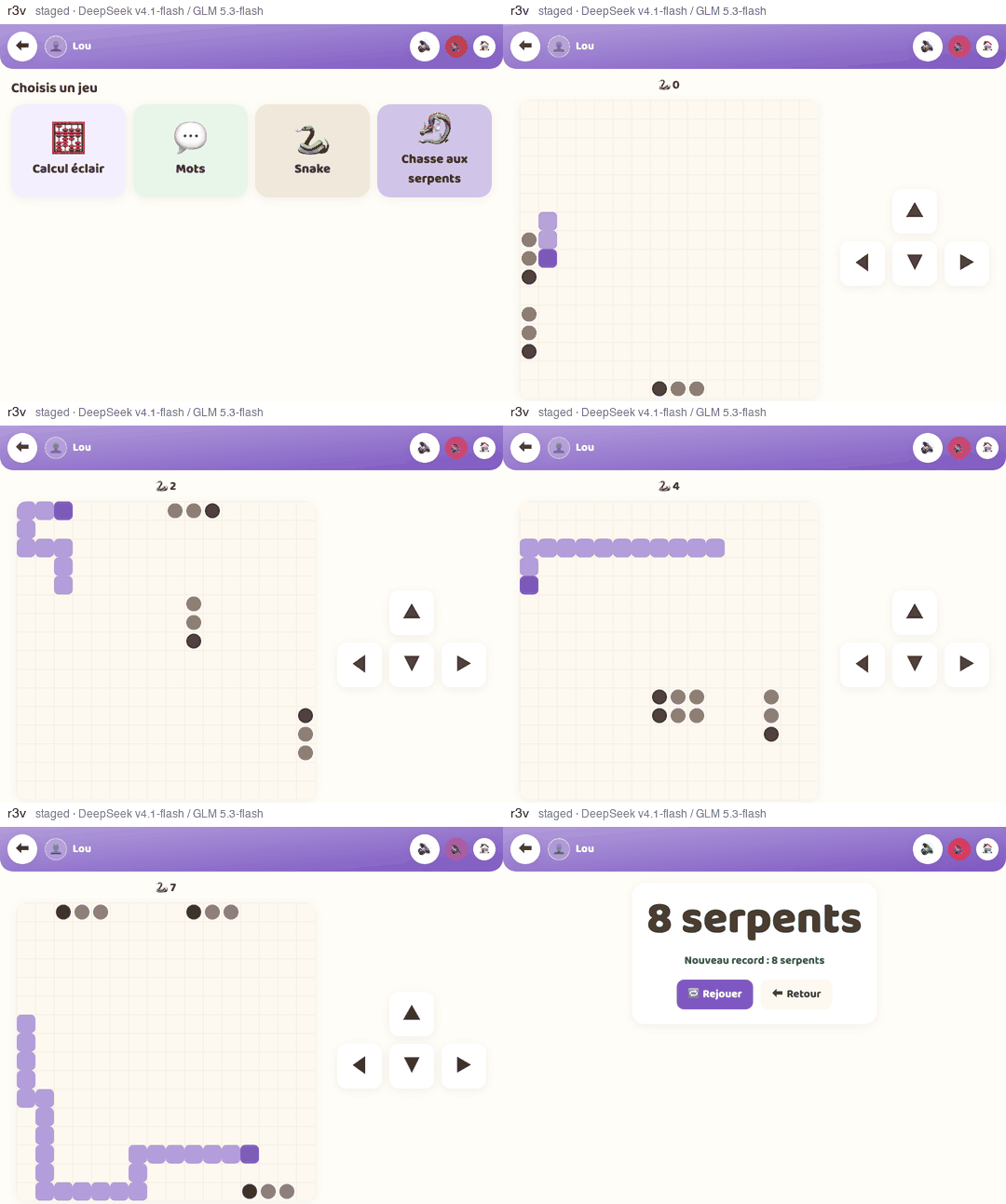
The same scripted game was recorded on every build. This one is the build of DeepSeek-v4.1-flash and GLM-5.3-flash (r3v in the tables below).
Each of the four builds added 740 to 819 lines of production code and 1,686 to 2,574 lines of unit tests. The writing of the spec and its reviews are not counted in any of the figures below.
The configurations
| Build | Tier | Plan, review, e2e generation, retrospective | Implement |
|---|---|---|---|
y3f | larger | Opus 5.5 | Sonnet 5.5 |
m8w | larger | GLM-5.3 | DeepSeek-v4.1-flash |
h5k | smaller | Sonnet 5.5 | Haiku 5.5 |
r3v | smaller | DeepSeek-v4.1-flash | GLM-5.3-flash |
Claude Code is the harness in the four builds. For the open models it ran with an API key, and my LiteLLM gateway sent every request to OpenRouter, with no call to Anthropic. No build had a senior model set, so a blocked step stopped and waited for me.
The staged workflow
My orchestrator starts every step as its own agent session: three sessions per story (plan, implement, review), each on its own model. Around the build sit the spec gate, the unit-test verification, the e2e test generation, the e2e quality gate and the retrospective. Every agent step writes a marker file with its status; a step that leaves no readable marker is retried once. The diagram shows where the work goes back after a failure.
flowchart TB
  gate[Spec gate, plan model]:::agent
  subgraph story [Each story, agents retried once]
    plan[Plan, plan model]:::agent --> impl[Implement, implement model]:::agent
    impl --> verify(Verify: unit tests):::check
    verify --> review[Review, review model]:::agent
  end
  gate --> plan
  verify -. fails: redo, max 2 .-> impl
  review --> more{More stories?}:::check
  more -->|yes| plan
  more -->|no| gen[E2E generation, plan model]:::agent
  gen --> e2e(E2E quality gate):::check
  e2e -. fails: redo, max 2 .-> gen
  e2e --> retro[Retrospective, plan model]:::agent
  retro --> pr([Pushed, link for the PR]):::check
  story -. blocked .-> senior[Senior consult, if set]:::agent
  verify -. still fails .-> senior
  senior -->|decision| story
  senior -. not set .-> park([Park for a person]):::gate
  gate -. blocked .-> park
  e2e -. still fails .-> park
  retro -. rejected .-> park
  classDef agent fill:#ffffff,stroke:#3d4654,color:#111827
  classDef check fill:#f2f5f4,stroke:#6b7280,color:#111827
  classDef gate fill:#e8f0ee,stroke:#006b56,stroke-width:2px,color:#111827
My orchestrator runs every Run in a container. Security is a big concern when using open models, so I always sandbox the environment when calling OpenRouter and open models. Inside the container, the code the model reads still goes to whichever provider serves the request, and each provider behind OpenRouter has its own data policy.
Sources.
- The specs follow the BMAD Method, which describes itself as “Agile AI-Driven Development” (BMAD Method documentation).
- OpenRouter’s rankings “do not rank models by accuracy, reasoning ability, or benchmark performance”; they rank usage (OpenRouter Rankings). “Among released weights, DeepSeek V4.1 Flash 1017 (max) and GLM-5.3 (max) lead at 32” (Artificial Analysis Intelligence Index v5, October 2026).
- “Each provider on OpenRouter has its own data handling policies” (Provider logging, OpenRouter documentation). Claude Code’s own sandbox documentation: “Don’t rely on any of the sandbox’s restrictions … to stop a malicious command” (Sandboxing, Claude Code documentation).
2. The findings
What surprised me was the cost. GLM cost as much as Claude, and it wrote a lot more.
I rated the four builds equally on the tablet, because the result was pretty much the same. The specification and the screen mockups were written before, so the agents only executed what was already written in the spec. But I was still surprised that they all performed equally.
The equivalence is measured on the four builds:
- A script played the same 6,000 games on the four game engines, with the same random draws and the same key presses: the four returned the same state at every step. One scripted game of 124 ticks also shows the same board at every tick on each build’s real screen.
- Each build’s unit tests pass on the other three builds’ code in 2,025 of 2,034 case runs, and its e2e specs on the other three apps in 765 of 765. The nine failures all come from one choice the spec left open: whether the board or the screen decides when to show the waiting label.
- The four are green on the repository’s full quality gate, with 93.38 to 93.65% line coverage.
- One rule of the spec was broken, by
m8w: it wrote a third e2e spec file where the spec names two.
One caution before the numbers: every configuration ran once. A difference below is a difference between two runs.
| Build | Models | Cost | Prompt tokens | Output tokens | Tool calls | Minutes running |
|---|---|---|---|---|---|---|
y3f | Opus / Sonnet | $16.50 | 22.3M | 219k | 323 | 122 |
m8w | GLM-5.3 / DeepSeek-v4.1-flash | $21.03 | 194.2M | 2,373k | 1,988 | 286 |
h5k | Sonnet / Haiku | $2.77 to $3.50 | 17.8M | 209k | 214 | 90 |
r3v | DeepSeek-v4.1-flash / GLM-5.3-flash | $2.72 | 112.0M | 1,737k | 1,677 | 247 |
The cost is a price, not a bill: my LiteLLM gateway priced each request at API rates (November 2026), Claude’s for the Claude models and OpenRouter’s list prices for the open models. I have not checked the open-model figures against what OpenRouter actually charged, and OpenRouter can send each request to a different provider at a different price. For h5k the gateway had no price for Haiku above 100k tokens of context, so its figure is a lower bound; the upper figure is Claude Code’s own estimate, minus one attempt it counts twice. Prompt tokens include cache reads.
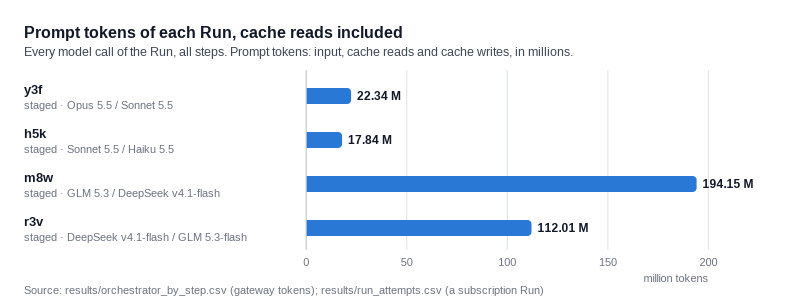
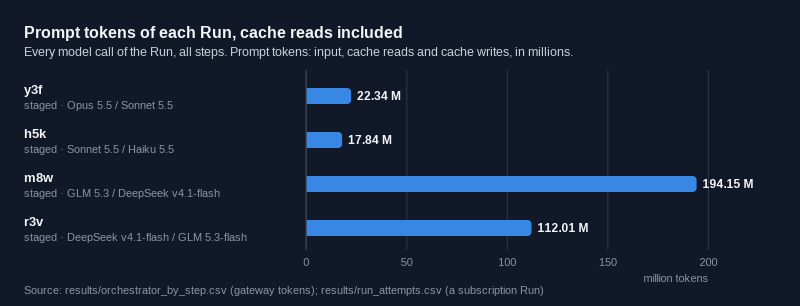
Two things stand out:
- The open models used six to nine times more prompt tokens and six to eight times more tool calls than the Claude build of the same tier.
- In
m8w, much of that was waiting: 732 of its 1,988 tool calls were sleeps, polls or repeats of one failed wake-up call, and each poll re-read the whole conversation.r3vwaited less (64 sleeps or polls) and ran its unit tests more (134 times, versus 70 inm8w). The two Claude runs had 8 and 10 sleeps or polls.
This experience went a lot better than my previous experiments with open models in the OpenClaw setup. The big difference was, of course, the specification written at the beginning and validated by a human. Also, the workflow was orchestrated by my orchestrator, so there was no babysitting anymore.
3. Interesting insights
| # | Question | Short answer |
|---|---|---|
| 1 | How do open models perform against Claude models in the same harness? | They delivered the same game, green on the full quality gate. They took two to three times longer and used six to nine times more tokens. |
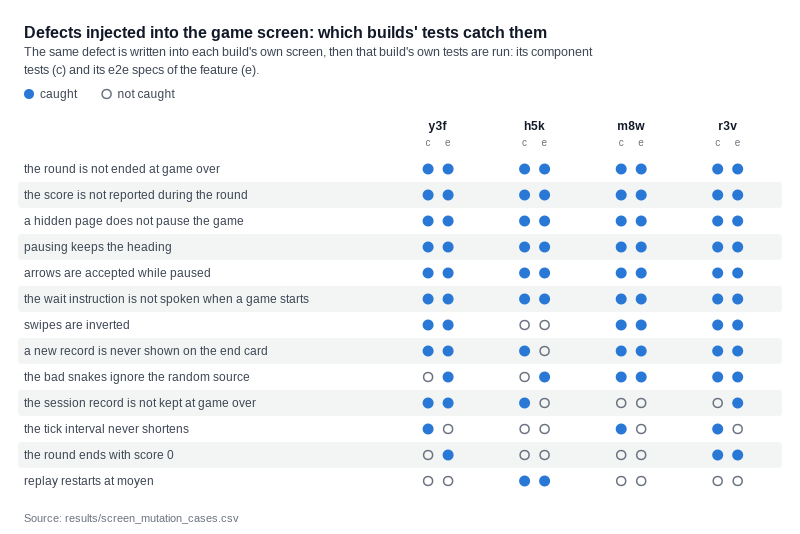
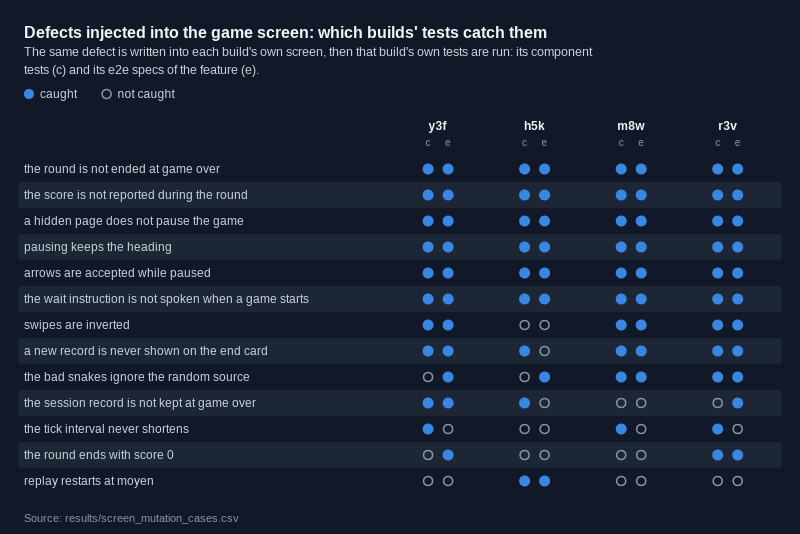
| 2 | What differs in the unit tests, the coverage and the e2e tests? | The repository’s coverage does not differ (93.38 to 93.65%); on the game screens it runs from 95.28 to 100%. GLM and DeepSeek wrote the most tests; they catch 10 of 13 defects injected into the game screen, the same as Sonnet and Haiku, which wrote the fewest. |
| 3 | Did they need more senior validation, or were they autonomous? Were they retried more? | They were as autonomous as Claude. No senior model was set on any run. GLM and DeepSeek never stopped; DeepSeek and GLM-flash stopped twice, once when the OpenRouter credits ran out and once when the run’s retrospective rejected the epic over the spec’s base commit. |
| 4 | How much did they cost compared with Claude models of the same tier? | 27% more than Opus and Sonnet on the larger tier, the same as Sonnet and Haiku on the smaller one. |
| 5 | Which open model is a good compromise between quality and price? | DeepSeek-v4.1-flash: the cheapest in both roles it held. Most of the cost of the GLM and DeepSeek run was GLM-5.3’s. |
| 6 | Where did the extra tokens and tool calls go? | In the GLM and DeepSeek run, much of it into waiting: sleeps, polls, and one tool called 299 times without a required field. The failure rate of the other calls is the same as Claude’s. |
More details on each of these questions below.
1. How do open models perform against Claude models in the same harness?
| Build | Engine games that differ (of 6,000) | Full quality gate: unit / e2e tests passing | Spec rules broken (of 14) | My rating on the tablet |
|---|---|---|---|---|
y3f | 0 | 1,801 / 678 | 0 | same |
m8w | 0 | 1,838 / 696 | 1 | same |
h5k | 0 | 1,793 / 657 | 0 | same (not blind) |
r3v | 0 | 1,814 / 672 | 0 | same |
The open models took longer: 286 and 247 minutes of steps running, compared with 122 and 90. The development time is not that important to me: I write the specs, then I let it run in auto mode, sometimes overnight or while I’m busy doing something else.
2. What differs in the unit tests, the coverage and the e2e tests?
| Build | Unit-test cases written | E2E cases written | Line coverage of the game screens | Engine defects caught (of 16) | Screen defects caught, component / e2e / either (of 13) |
|---|---|---|---|---|---|
y3f | 100 | 24 | 100% | 13 | 10 / 11 / 12 |
m8w | 135 | 30 | 99.58% | 13 | 10 / 9 / 10 |
h5k | 93 | 17 | 95.28% | 13 | 9 / 8 / 10 |
r3v | 113 | 21 | 100% | 13 | 11 / 11 / 12 |
I injected 16 defects into each build’s game engine and 13 into each build’s game screen, then ran that build’s own tests. On the engine the four suites catch the same 13 and miss the same 3, the ones the acceptance criteria do not describe. On the screen they differ, and suite size does not explain it: m8w wrote the most tests and catches 10, like h5k, which wrote the fewest. r3v catches 12, like y3f.
3. Did they need more senior validation, or were they autonomous?
| Build | Failed attempts | Steps sent back | Parks | Minutes waiting for me | Cause of the parks |
|---|---|---|---|---|---|
y3f | 3 | 2 | 1 | 100 | an earlier agent’s test server still held the e2e port |
m8w | 0 | 0 | 0 | 0 | — |
h5k | 3 | 0 | 3 | 32 | a submodule update timed out twice; one sentence of the spec |
r3v | 2 | 0 | 2 | 181 | OpenRouter out of credits; the retrospective rejected the epic on the spec’s base commit |
No run had a senior model set, so every block came to me. The GLM and DeepSeek run is the only one of the four that never failed a step and never stopped. None of the parks was an agent stuck on the code. r3v’s retrospective read the spec literally: the spec names a base commit the benchmark did not run on. The other retrospectives noticed it too; this one made it a verdict. The OpenRouter stop was on me: the credits ran out in the middle of a review, I added $10, and the run went on.
4. How much did they cost compared with Claude models of the same tier?
| Step | y3f Opus / Sonnet | m8w GLM / DeepSeek | h5k Sonnet / Haiku | r3v DeepSeek / GLM-flash |
|---|---|---|---|---|
| Spec gate | $0.60 | $0.04 | $0.18 | $0.02 |
| Plan, three stories | $3.36 | $1.75 | $1.23 | $0.11 |
| Implement, three stories | $2.82 | $0.29 | $0.31 | $1.37 |
| Review, three stories | $2.55 | $4.89 | $0.58 | $0.31 |
| E2E generation | $2.43 | $5.43 | $0.15 | $0.16 |
| Retrospective | $4.73 | $8.63 | $0.32 | $0.74 |
| Run | $16.50 | $21.03 | $2.77 | $2.72 |
Most of the open-model cost was around the code, not in it. In m8w the review, the e2e generation and the retrospective cost $18.96; writing the code cost $0.29.
The list prices alone do not explain these totals. At Z.ai’s own price, GLM-5.3 charges $0.26 per million cache-read tokens, more than Opus 5.5’s $0.20; at Z.ai’s prices of November 22 the GLM-5.3 steps of m8w would have cost about $56, compared with the $20.74 my gateway counted. OpenRouter picks a provider for each request, among 47 for GLM-5.3, at different prices, so the actual bill is the figure I still need to check.
Honestly, I thought the open models were expensive, compared with a Claude subscription: Pro at $20, Max at $100 or Ultra at $200 a month (November 2026). Requests that Claude Code sends through a gateway are outside the subscription’s usage limits: I pay for them per token. Here the open models performed equivalently, but compared with a Claude subscription, it’s a no-brainer: as of November 2026, the best way to go is to keep a frontier model subscription, since we get a crazy amount of value for a ridiculously low cost of $200.
5. Which open model is a good compromise between quality and price?
| Model | Role, build | Cost of that role | What it did |
|---|---|---|---|
| DeepSeek-v4.1-flash | implement, m8w | $0.29 | Wrote the three stories in three attempts |
| DeepSeek-v4.1-flash | spec gate, plan, review, e2e generation, retrospective, r3v | $1.35 | The most review patches of the four (4, three of them on tests) |
| GLM-5.3-flash | implement, r3v | $1.37 | Half of the run’s cost; hit and fixed 17 test, type, lint and e2e failures in story 3 |
| GLM-5.3 | spec gate, plan, review, e2e generation, retrospective, m8w | $20.74 | Most of the waiting (question 6) |
DeepSeek-v4.1-flash is the compromise in this benchmark. No run used it in every role, so that is the next run to make. If I were to use GLM and DeepSeek in my process, I would also evaluate the tuning and the different parameters available.
6. Where did the extra tokens and tool calls go?
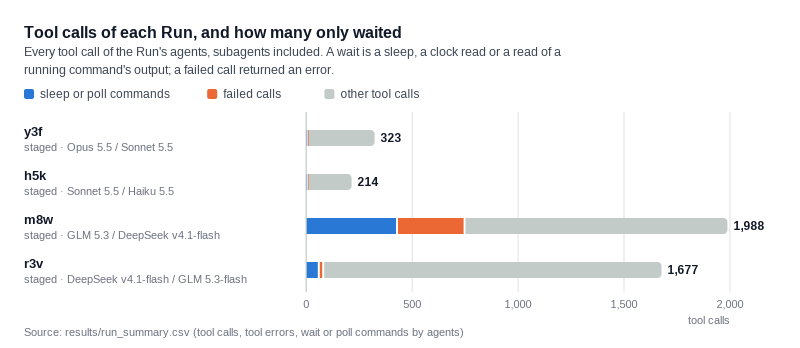
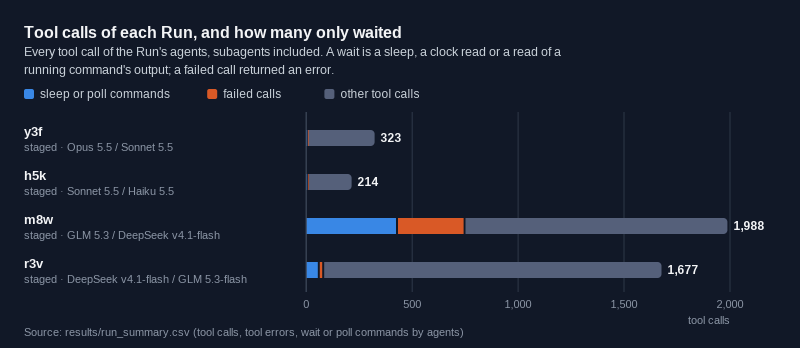
In m8w, 732 of 1,988 tool calls were waiting. During one review, GLM-5.3 called Claude Code’s wake-up tool without a field the tool requires, asking to be called back when its tests and its subagents finished, and sent the same call again 299 times in eleven minutes. During the e2e generation, while the ten-minute e2e suite ran, it started 105 background sleeps and checked the clock every one to three seconds: each check re-read the whole conversation. The e2e generation and the retrospective cost $14.07 of the run’s $21.03, and wrote no production code.
Without that one tool, the open models fail 1.2 to 1.3% of their tool calls, the same as the Claude models (1.2 to 1.4%). So the tooling did not fail more often; the open models used it differently. The wake-up tool GLM-5.3 kept calling is meant for Claude Code’s /loop command, not for waiting on a test run. Claude Code can run a command in the background and keep working while it runs; in the Claude runs, the agent mostly ended its turn and was woken when the command was done.
I think this comes from a tuning mismatch between the Claude Code harness and these models. It is not that they are unsupported: Z.ai and DeepSeek both document Claude Code as a client of their own endpoints. My route was different (LiteLLM, then OpenRouter, then whichever provider OpenRouter picked), and Anthropic does not support routing Claude Code to non-Claude models through a gateway. A 2026 study ran the same two flash models, among others, in Claude Code and in other harnesses: changing the harness changed about as many results as a rerun, and GLM-5.3-flash cost three to four times as much in Claude Code as in OpenCode, with “no detectable gain in passes”. It is a different experiment (the harness changed, not the model), but the pattern is the one I see here: the cost moves much more than the result. On the other hand, DeepSeek’s own model card scores DeepSeek-v4.1-flash higher in Claude Code (69.8) than in Codex (65.6) or OpenCode (65.5) on one coding benchmark.
Sources.
- Claude Code computes its own dollar figure “locally from token counts at list price”, as an estimate (Manage costs effectively, Claude Code documentation).
- Claude API prices, November 2026: cache reads $0.20 per million tokens on Opus 5.5, $0.10 on Sonnet 5.5, $0.01 on Haiku 5.5 up to 100k tokens (Pricing, Claude API documentation). GLM-5.3 on Z.ai’s endpoint: $1.40 input, $4.40 output, $0.26 cache read per million tokens (OpenRouter, GLM-5.3 endpoints); DeepSeek-v4.1-flash on 37 endpoints (OpenRouter, DeepSeek-v4.1-flash endpoints). Prices fetched on 2026-11-22.
- Pro “$20 if billed monthly”, Max “$100”, Ultra “$200” (Plans and pricing, Claude).
ScheduleWakeup“Reschedules the next iteration of a self-paced/loop” (Tools reference, Claude Code documentation).- Z.ai: “We have verified compatibility with Claude Code 2.0.14 and other versions” (Claude Code, Z.ai documentation); DeepSeek’s Claude Code setup (Integrate with Claude Code, DeepSeek API documentation). Anthropic “doesn’t support routing Claude Code to non-Claude models through any gateway”, and “While a gateway credential variable or
apiKeyHelperis active, … the subscription’s usage limits don’t apply to them” (Other LLM gateways, Claude Code documentation).- “a harness swap changes about as many task outcomes as a rerun”; “3 to 4 times as much with GLM-5.3-Flash”; “the extra spending bought no detectable gain in passes” (What Does a Harness Buy? Tokens, Mostly, 2026 preprint). DeepSeek’s scaffold table, DeepSWE: Claude Code 69.8, Codex 65.6, OpenCode 65.5 (DeepSeek-V4.1-Flash model card).
Conclusion
I would use open models in my orchestrator, more specifically for the implementation step. I care about open models to avoid being locked in to one vendor, and for self-hosting when the machines are available. But right now I don’t think it is worth canceling the frontier subscription I have.
As next steps, I will test the OpenCode and Codex harnesses with the same models, to see whether they perform equivalently. I also have a Mac mini M4 where I will run evaluations of open models with a relatively small context window, at least for the code implementation step. I think the implementation step would run okay, but larger stories might need to be split into smaller steps.